
close
Choose Your Site
Global
Social Media


Views: 0 Author: Site Editor Publish Time: 2026-09-05 Origin: Site


Quick Answer: A heavy-duty brake shoe is the rigid metal structural foundation of a commercial drum brake system. It relies on attached brake linings to generate the critical friction required to stop high-mass vehicles safely. This guide explains the mechanical relationship between these components, details essential specifications like width and Gross Axle Weight Rating (GAWR), and outlines axle compatibility factors. The information provided supports early-stage technical evaluation and procurement decisions for heavy-duty fleet maintenance and manufacturing.
Key Takeaways:
Brake shoes act as the structural carrier, while brake linings supply the consumable friction material necessary for kinetic energy conversion.
Procurement requires matching specific widths, variable thicknesses, and GAWR capabilities to the vehicle's operational demands and axle ratings.
Heavy-duty brake linings must be engineered for specific axle brands and trailer types; universal fit does not apply to commercial drum brakes.
Regulatory compliance, such as FMVSS 121, relies on manufacturer testing and declaration to ensure stopping performance and vehicle stability.
Understanding how commercial vehicles safely decelerate requires distinguishing between the structural components and the friction materials within the wheel end. The drum brake system remains the standard for most heavy-duty applications due to its durability, cost-effectiveness, and ability to generate massive stopping power. At the core of this system is the mechanical relationship between the brake shoe and the brake lining.
The brake shoe is a crescent-shaped metal component that serves as the rigid carrier for the friction material. Manufactured from heavy-gauge steel, the shoe consists of two primary parts: the web and the table. The web provides the structural spine that resists the immense bending forces applied during braking, while the table provides the curved surface where the friction material is mounted. When evaluating Brake Shoes for commercial fleets, the integrity of these steel components is paramount, as any deflection under pressure will result in uneven braking and premature wear.
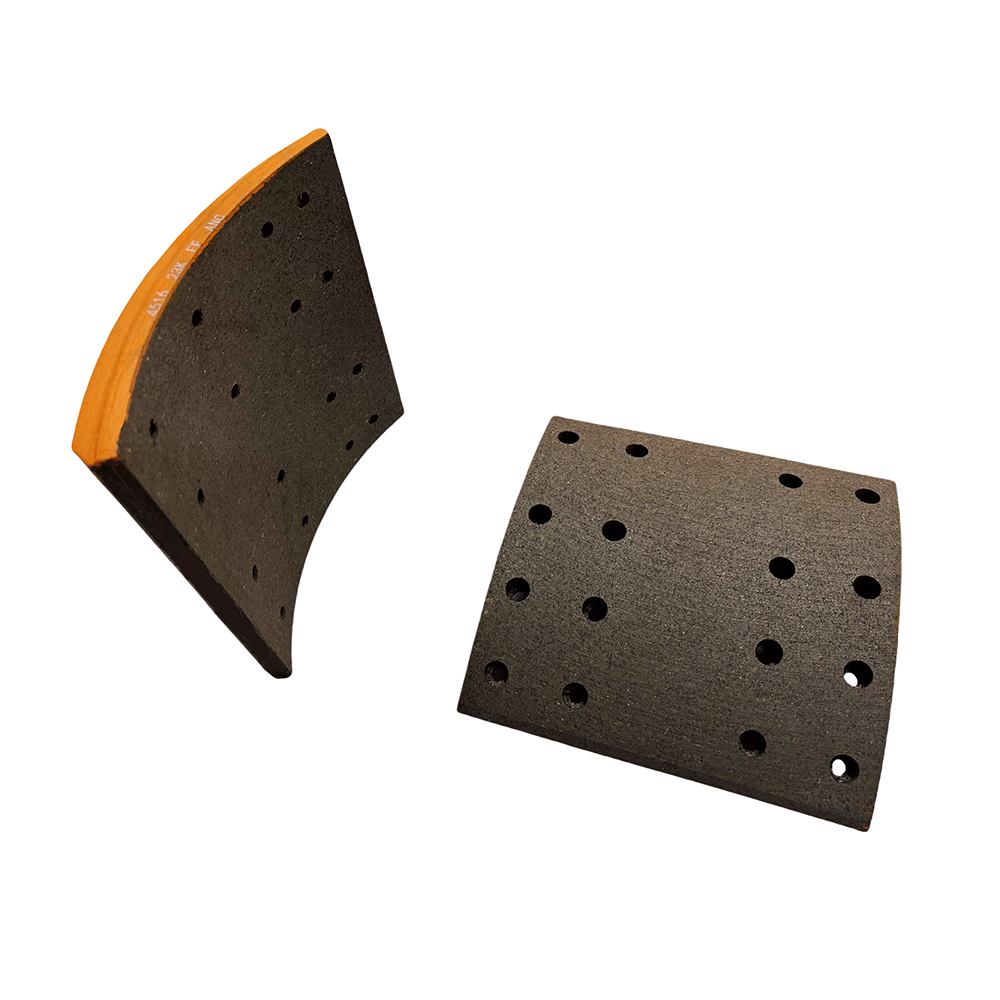
Attached directly to the table of the shoe are the Brake Linings. These are the consumable friction blocks that make physical contact with the rotating brake drum. In heavy-duty applications, linings are typically riveted to the shoe rather than bonded, as rivets provide superior shear strength and allow for more reliable performance under extreme thermal stress.
The braking process begins when pneumatic pressure from the vehicle's air system actuates a pushrod, which turns a slack adjuster and rotates an S-cam (or actuates a wedge mechanism) located between the ends of the brake shoes. As the S-cam rotates, it forces the brake shoes outward, pressing the brake linings against the inner machined surface of the brake drum.
This physical contact converts the kinetic energy of the moving vehicle into thermal energy through friction. A fully loaded commercial trailer can generate temperatures exceeding 600°F (315°C) during sustained downhill braking. The brake lining must maintain its coefficient of friction at these elevated temperatures without experiencing severe "brake fade"—a condition where the material loses its stopping capability due to thermal degradation. Consequently, the mechanical success of the entire system relies entirely on the lining's ability to manage heat while the steel shoe maintains absolute structural rigidity.
The extreme thermal and mechanical stresses generated during the actuation process dictate that heavy-duty friction materials meet highly specific dimensional and load-bearing tolerances. Procurement managers cannot rely on visual similarity when selecting replacement parts; they must evaluate precise engineering specifications to ensure vehicle safety and operational efficiency.
Zhejiang Dingchi Automotive Technology Co., Ltd. engineers brake components that demonstrate how these critical specifications align with heavy-duty operational demands. When evaluating friction materials, technical decision-makers must analyze three primary metrics: width, variable thickness geometry, and Gross Axle Weight Rating (GAWR) support.
Important limitations for brake lining procurement:
Dimensional specifications are not interchangeable between different drum sizes or axle configurations.
Friction material must be matched to the specific GAWR of the axle; under-specifying the lining will lead to catastrophic brake failure.
Variable thickness blocks must be installed in the correct orientation to match the S-cam actuation geometry.
The width of the brake lining directly determines the "swept area"—the total surface area of friction material that contacts the drum. A larger swept area distributes heat more effectively and reduces the thermal load on any single square inch of the lining. For example, specific heavy-duty linings are engineered with a precise width of 203.2 to maximize contact within compatible commercial drums, ensuring optimal heat dissipation during aggressive deceleration.
Thickness is equally critical, but heavy-duty linings are rarely uniform in thickness across the entire shoe. Because the S-cam pushes the shoes outward from a fixed pivot point, the lining does not contact the drum evenly at the exact same millisecond. To account for this actuation geometry and ensure even wear over the lifespan of the component, linings are manufactured with variable thickness options. A standard heavy-duty configuration might include block thicknesses of 18.2, a tapered block of 15.2-17.6, and an 11.1 block. This varied geometry ensures that as the lining wears down, the arc of the brake shoe continues to match the inner radius of the brake drum perfectly.
Finally, the friction material must be rated to support the vehicle's GAWR. The GAWR dictates the maximum distributed weight that a single axle can safely carry. Brake linings are formulated with specific friction coefficients and structural densities to halt these specific masses. Heavy-duty linings must be explicitly rated for high-capacity applications, commonly supporting GAWR benchmarks of 20,000 lbs and 23,000 lbs. Installing a lining rated for a 12,000 lb axle on a 23,000 lb trailer axle will result in rapid material disintegration and a failure to meet mandated stopping distances.
Because dimensional and load-bearing specifications are so precise, heavy-duty friction materials cannot be treated as interchangeable commodities. The assumption of a "universal fit" is a dangerous misconception in commercial vehicle maintenance. Brake linings must be explicitly matched to the engineering tolerances of the specific axle brand and the operational profile of the trailer.
The integration of the brake shoe, lining, and drum is a closed mechanical ecosystem. Different axle manufacturers utilize proprietary S-cam profiles, spider mountings, and drum dimensions. Therefore, the friction material must be engineered to interface seamlessly with these specific designs. For instance, the majority of Dingchi's BC brand products are engineered to be compatible with industry-leading axle configurations, including Meritor, BPW, and Eaton axles. This compatibility ensures that fleet operators utilizing these common axle types can achieve original equipment (OE) level braking performance without risking mechanical binding or uneven wear patterns.
Beyond the axle itself, the specific application of the trailer dictates the necessary brake lining engineering. Different trailer types—such as flatbeds, refrigerated units, or heavy haulers—impose different dynamic loads on the braking system during transit. To address these specific operational scenarios, manufacturers engineer targeted solutions. A verified example is the 4516 BRAKE LINING CA32, which is engineered specifically for YORK and FRUEHAUF heavy-duty vehicles. By aligning the friction material's performance characteristics with the specific suspension and load dynamics of YORK and FRUEHAUF trailers, fleets ensure predictable stopping power and maximized maintenance intervals.
The necessity for precise axle and trailer compatibility is a global requirement. Commercial transport operates across vastly different topographies and regulatory environments, requiring friction materials that can perform reliably regardless of the region. Dingchi exports 70% of its products to over 20 countries, illustrating the necessity of manufacturing brake linings that meet diverse, international axle specifications and heavy-duty application scenarios. Fleet managers must always verify that the selected brake lining is explicitly cataloged for their exact axle make, model, and weight rating before procurement.
The brake shoe is the permanent, rigid metal carrier made of steel that provides the structural foundation for the braking mechanism. The brake lining is the consumable friction material that is riveted or bonded to the shoe. While the metal shoe can often be remanufactured and reused, the lining is designed to wear down over time as it converts kinetic energy into heat, requiring periodic replacement.
Heavy-duty brake linings are manufactured from complex composite materials designed to balance friction generation, heat resistance, and drum wear. Common formulations include semi-metallic blends (incorporating steel or copper fibers for heat dissipation), non-asbestos organic (NAO) materials, and ceramic compounds. The specific formulation determines the lining's friction coefficient and its ability to resist thermal degradation under heavy loads.
Federal Motor Vehicle Safety Standard (FMVSS) 121 regulates the performance and testing of air brake systems on commercial vehicles, focusing on stopping distance and vehicle stability. Compliance with this standard is typically verified through manufacturer testing and self-declaration rather than independent third-party certification bodies. For example, Dingchi states that the 4516 model complies with FMVSS 121 requirements, indicating the manufacturer has engineered the product to meet these specific regulatory performance metrics.
The lifespan of a heavy-duty brake shoe and its lining cannot be measured in absolute timeframes, as it depends entirely on operational variables. Key factors include the vehicle's operating weight (GAWR utilization), the topography of the routes (mountainous terrain requires more frequent, aggressive braking), driver behavior, and the condition of the brake drums. Regular maintenance inspections are required to measure lining thickness and ensure the material has not worn past the manufacturer's minimum safety specifications.
For detailed specifications on heavy-duty friction materials, review our technical selection guide or explore the full range of heavy-duty brake linings to ensure compatibility with your fleet's axle configurations and load requirements.


