
close
Choose Your Site
Global
Social Media


Views: 0 Author: Site Editor Publish Time: 2026-09-12 Origin: Site


Quick Answer: Identifying brake lining wear in heavy-duty commercial vehicles relies on strict mileage intervals and physical thickness measurements rather than subjective auditory cues, which are often unreliable in industrial environments. For standard heavy-duty applications, such as those utilizing the 4702 brake lining, fleet managers should conduct physical inspections every 10,000 to 15,000 miles. The lining must be replaced immediately if its thickness drops below the critical threshold of 11.0mm. This article outlines how to audit commercial brake wear, the impact of mechanic errors on friction materials, and how maintaining these thresholds ensures FMVSS 121 compliance for high-GAWR applications.
Key Takeaways:
Heavy-duty brake linings require routine physical inspections every 10,000 to 15,000 miles to monitor material degradation accurately.
Linings such as the 4702 model must be replaced when thickness falls below 11.0mm to maintain safe stopping distances and structural integrity.
Mechanic installation errors and the selection of improper friction materials significantly accelerate brake lining wear, leading to premature failure.
Maintaining proper lining thickness is critical for upholding FMVSS 121 federal standards and safely supporting heavy Gross Axle Weight Ratings (GAWR) of 20,000lbs to 23,000lbs.
Commercial fleet maintenance requires moving away from subjective wear indicators, such as listening for squeaks or grinding, and adopting objective, data-driven baseline metrics. In heavy-duty environments, ambient engine noise, road vibration, and the mechanics of air brake systems often mask the auditory cues common in passenger vehicles. Therefore, wear must be measured strictly through physical thickness verification and precise mileage tracking. Establishing these baselines requires looking at specific, high-performance components manufactured for demanding commercial environments, ensuring that maintenance protocols are grounded in verified engineering data.
For example, Zhejiang Dingchi Automotive Technology Co., Ltd. (operating under the registered brand 'BC') is a global manufacturer and supplier of brake system components for heavy-duty trucks and trailers. Producing over 90 specifications of brake shoes and over 50 specifications of brake linings, the company exports 70% of its products to over 20 countries. While their broader product lines are primarily compatible with Meritor, BPW, and Eaton axles, specific models are engineered for highly targeted applications. When selecting Brake Linings for heavy-duty vehicles, fleet managers must rely on the exact specifications provided for the specific model in use to determine wear limits.
The Dingchi 4702 model serves as a primary benchmark for heavy-duty applications in this context. This specific lining is optimized for heavy-duty models equipped with 381mm brake drums, such as the Ford F-650, F-750, and L-Series, as well as RECKWELL heavy-duty equipment. By utilizing the 4702 model as a baseline, maintenance teams can establish a standardized approach to measuring wear across compatible assets. Instead of waiting for noticeable performance degradation or driver complaints, technicians track the physical reduction of the friction material over set mileage intervals. This objective measurement ensures that the vehicle maintains its structural safety and stopping power under heavy loads without relying on guesswork.
Important limitation:
The specific wear metrics, including the 11.0mm thickness threshold and the 10,000 to 15,000-mile inspection intervals discussed in this guide, are specific benchmarks based on the 4702 model specifications. They are not universal rules for all brakes ever manufactured.
Compatibility is strictly limited to heavy-duty models with 381mm brake drums; these linings are not compatible with all commercial vehicles. Always consult the specific manufacturer data for the exact lining model installed on your fleet vehicles.
Translating baseline metrics into an actionable maintenance schedule is the next critical step for fleet operators. Based on the benchmark established by the 4702 model, heavy-duty brake linings require a strict, routine audit to ensure operational safety and prevent catastrophic failure under load.
The standard inspection interval for these heavy-duty applications is every 10,000 to 15,000 miles. During this interval, technicians must perform a comprehensive physical audit of the brake assembly. The most critical metric verified during this audit is the remaining thickness of the friction material. For the 4702 model, the lining must be replaced immediately if its thickness drops below 11.0mm. Operating a commercial vehicle with lining thickness below this threshold severely compromises stopping distance, heat dissipation capabilities, and overall structural integrity.
To standardize this process across a fleet, maintenance teams should implement the following physical inspection checklist during every 10,000 to 15,000-mile service interval:
Mileage Verification: Confirm the vehicle has reached the 10,000 to 15,000-mile threshold since the last documented brake service or inspection.
Visual Drum Inspection: Ensure the 381mm brake drum is free from deep scoring, heat checking, or cracking, which can rapidly accelerate lining wear and compromise the friction material's structural integrity.
Physical Thickness Measurement: Use a calibrated brake lining thickness gauge or micrometer to measure the friction material accurately at its thinnest point, ensuring precision rather than visual estimation.
Threshold Comparison: Compare the measured thickness directly against the 11.0mm minimum safe threshold specified for the 4702 model.
Replacement Execution: If the measurement reads 11.0mm or below, initiate immediate replacement of the brake lining before returning the commercial vehicle to active service.
Hardware Audit: Inspect all associated foundation brake hardware, including return springs, rollers, and anchor pins, for fatigue, as worn hardware can cause uneven lining wear.
Documentation and Compliance Tracking: Record the measured thickness in the fleet maintenance log to track the wear rate over time, ensuring a verifiable audit trail for safety compliance.
Adhering strictly to this checklist ensures that wear is identified before it impacts vehicle safety. Relying on physical measurements at specific mileage intervals eliminates the ambiguity associated with commercial brake maintenance and provides a verifiable record of fleet safety compliance.
Even with a strict 10,000 to 15,000-mile inspection schedule in place, certain variables can cause linings to degrade faster than anticipated, breaching the 11.0mm threshold prematurely. Understanding these risk factors is essential for preventing unexpected maintenance downtime and maintaining fleet safety.
One of the primary causes of accelerated degradation is improper installation. When auditing maintenance procedures, fleet managers must evaluate a critical question: Can Brake Linings Wear Quickly Due To Mechanic errors? The answer is a definitive yes. When technicians fail to properly adjust the slack adjusters, incorrectly torque the mounting hardware, or neglect to lubricate the foundation brake components, the brake lining can drag continuously against the drum. This constant friction generates excessive heat and rapidly wears down the material, often long before the vehicle reaches its next scheduled 10,000-mile inspection. This highlights the critical need for rigorous mechanic training and quality control during installation.
Beyond installation errors, the physical properties of the friction material itself play a significant role in how quickly a brake lining wears under heavy loads. Understanding what friction materials are used for brake linings helps explain why certain compounds degrade faster in specific applications. Heavy-duty commercial vehicles require robust friction materials engineered to withstand extreme temperatures and high-pressure applications. If a lining is manufactured with substandard friction compounds, it will lack the necessary thermal stability. Under the stress of heavy commercial braking, these inferior materials will glaze, crack, or rapidly disintegrate, leading to premature failure and a rapid drop below the 11.0mm safety threshold.
By ensuring that mechanics follow precise installation protocols and that the fleet utilizes high-quality friction materials designed specifically for heavy-duty applications, operators can mitigate the risks of premature wear and ensure their components reach their expected service life.
Mitigating premature wear and strictly adhering to the 11.0mm thickness threshold are not merely best practices for asset management; they are fundamental requirements for regulatory compliance and structural safety. For heavy-duty commercial vehicles, the physical condition of the brake lining directly dictates the vehicle's ability to meet federal safety standards.
The Dingchi 4702 model is engineered to be compliant with FMVSS 121 federal standards. This critical certification guarantees that the brake lining meets stringent federal requirements for stopping distance, heat resistance, and overall structural safety. However, this compliance is contingent upon the lining maintaining its structural integrity and remaining above the 11.0mm minimum thickness. Once the material wears below this benchmark, the brake system can no longer guarantee the stopping distances mandated by FMVSS 121, rendering the vehicle non-compliant and unsafe for highway operation.
Furthermore, maintaining proper lining thickness is essential for supporting massive commercial loads. The 4702 model is specifically designed to support Gross Axle Weight Ratings (GAWR) of 20,000lbs and 23,000lbs. When a vehicle is operating at or near these maximum GAWR limits, the kinetic energy generated during braking is immense, requiring substantial friction material to safely halt the vehicle's momentum. The brake lining must possess sufficient mass and thickness to absorb and dissipate this energy without experiencing brake fade. Allowing the lining to wear below the 11.0mm threshold severely compromises its heat dissipation capacity. This reduction in material mass means the brakes will run hotter, increasing the risk of thermal degradation and directly threatening the structural safety of the vehicle when carrying 20,000lbs to 23,000lbs loads.
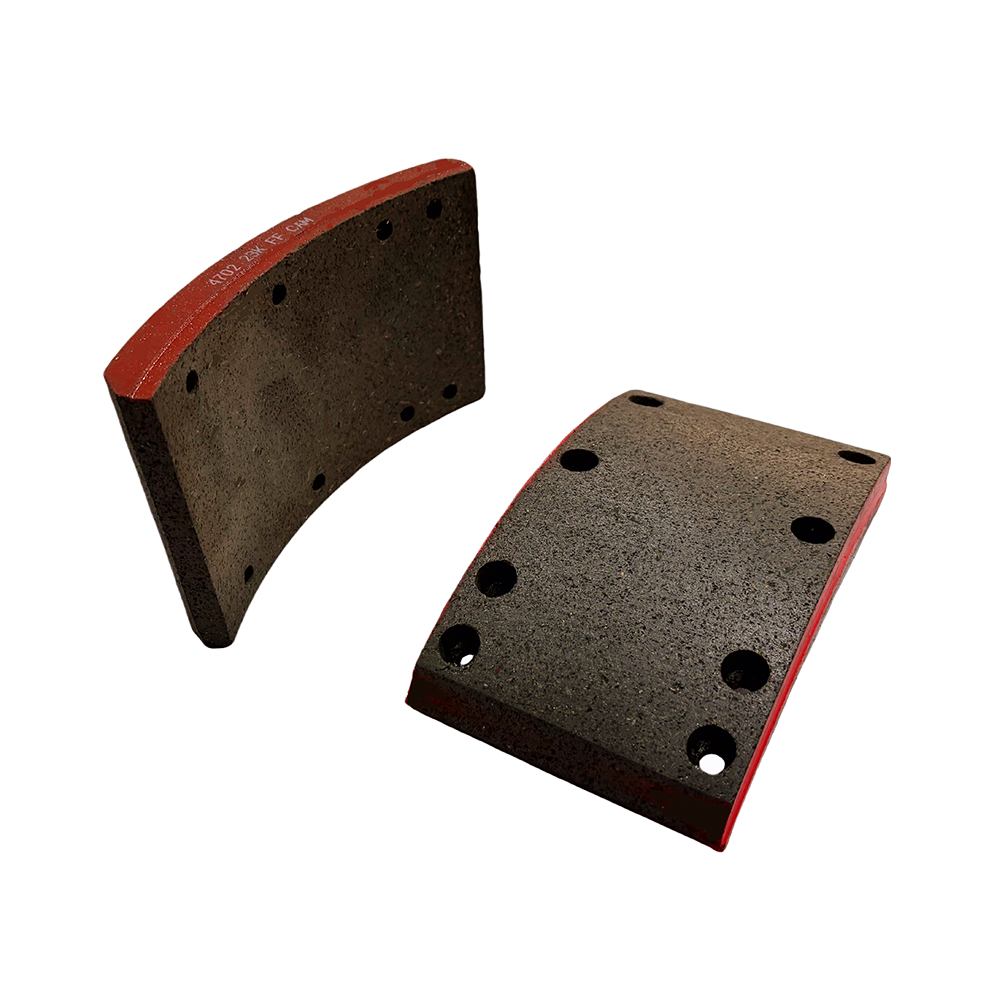
For standard heavy-duty applications utilizing components like the 4702 model, physical inspections should be conducted every 10,000 to 15,000 miles. This interval ensures that wear is tracked objectively before the friction material degrades below safe operating levels.
Based on the benchmark specifications of the 4702 model, the minimum safe thickness is 11.0mm. If a physical measurement reveals that the lining has dropped below this 11.0mm threshold, it must be replaced immediately to maintain stopping power, heat resistance, and regulatory compliance.
Yes. Installation errors, such as improper hardware torque, incorrect slack adjuster calibration, or failure to lubricate foundation components, can cause the lining to drag against the drum. This generates excessive heat and accelerates material degradation well before the standard inspection interval.
For detailed specifications on heavy-duty friction materials or to ensure your fleet meets FMVSS 121 standards, consult our commercial brake lining selection guide or download our routine maintenance checklist to standardize your inspection protocols.


