
close
Choose Your Site
Global
Social Media


Views: 0 Author: Site Editor Publish Time: 2026-08-08 Origin: Site


Paying for a recent brake service only to hear grinding or feel reduced stopping power shortly after is incredibly frustrating. You naturally expect fresh components to deliver thousands of miles of safe, silent stopping. When they fail early, you feel cheated. However, premature wear is rarely a mystery. It is typically a symptom of a larger systemic failure. This rapid degradation frequently stems from improper installation, substandard parts, or hidden hydraulic issues left unchecked. We must shift the focus away from subjective blame. Instead, we must look directly at mechanical evidence. This guide provides a straightforward framework for diagnosing the exact root cause of your stopping issues. We will show you how to properly document the failure for warranty claims. Finally, you will learn how to select a trustworthy service provider to fix the problem permanently without forcing you to pay twice.
You need to know what constitutes normal operation before diagnosing a problem. Standard OEM or premium aftermarket brake linings typically last between 30,000 and 70,000 miles. This wide range assumes standard driving conditions. Daily stop-and-go city traffic will naturally push you toward the lower end of that spectrum. Extensive highway cruising extends the lifespan significantly. When your components wear out in under 15,000 miles, you almost certainly have a mechanical problem. It is rarely just aggressive driving. You must investigate the physical system immediately to prevent further damage.
Symmetry is the ultimate indicator of a healthy stopping system. Your brake linings should wear completely evenly on both sides of the rotor. They must also wear evenly across the entire axle. The inner pad and the outer pad must press against the metal disc with equal force. More importantly, they must release at the exact same millisecond. If one pad looks brand new while the opposite pad is ground down to its metal backing plate, the system is failing. Uneven wear points directly to a mechanical bind or a hydraulic imbalance.
You can often spot premature wear well before a complete failure occurs. Pay close attention to these early warning signs:
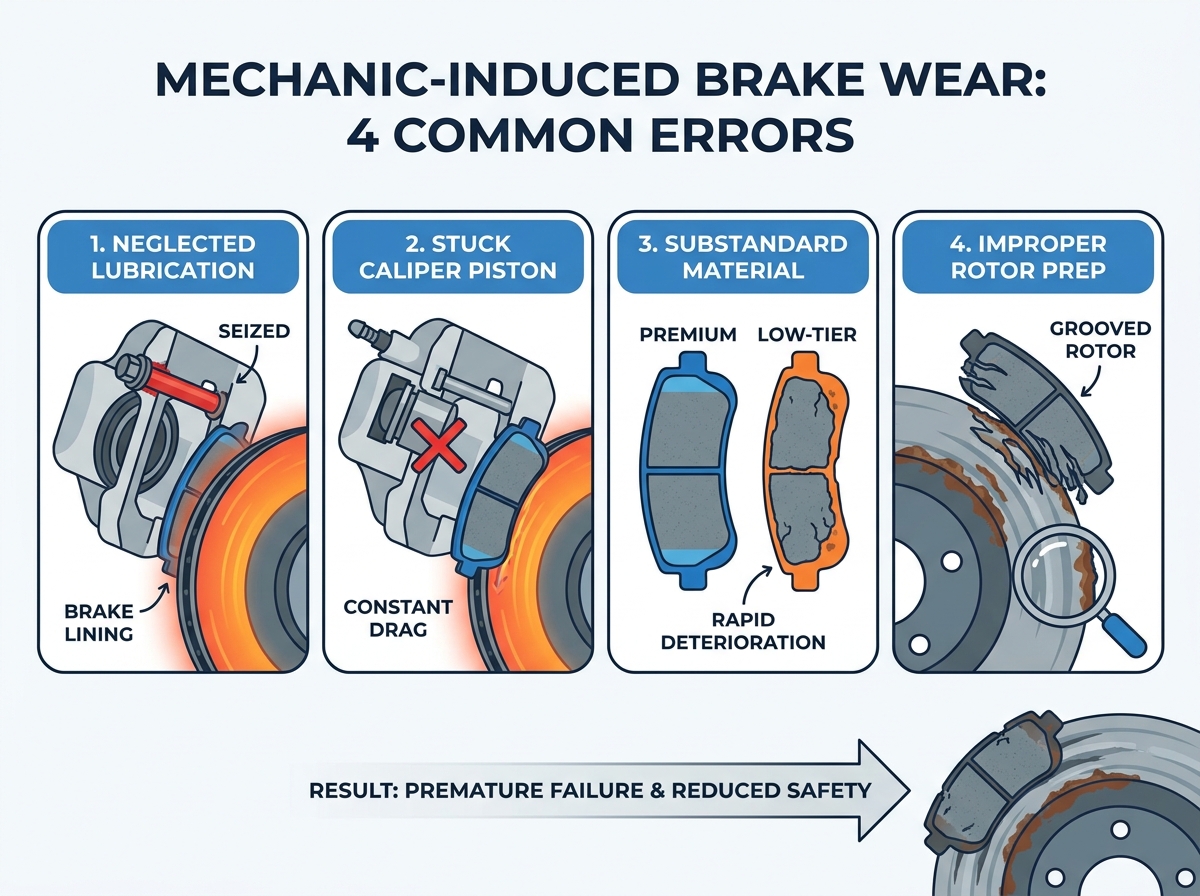
Mechanics sometimes rush through basic jobs to maximize their daily car count. Failing to clean and grease caliper slide pins is their most common error. These critical metal pins allow the caliper body to float smoothly back and forth. If a technician leaves old, hardened grease on the pins, the caliper binds tightly. This leaves the brake linings in constant, agonizing contact with the spinning rotor. The resulting friction burns through the fresh friction material in just a few short months.
Here is exactly how neglected slide pins destroy your components step-by-step:
A healthy caliper piston extends outward to apply pressure and retracts slightly when you lift your foot. Older metal pistons often develop exterior rust or internal rubber seal damage. A careless mechanic might force a heavily seized piston back into the caliper body using a massive C-clamp. They compress the damaged part instead of properly rebuilding or replacing it. Once installed, this damaged piston will absolutely not retract properly. It guarantees continuous, heavy drag on the wheel.
Part swapping remains an unfortunate reality in some dishonest repair shops. You might receive an expensive bill for premium ceramic components. However, the mechanic might actually pull cheap, low-tier replacements from the back room. These inferior parts degrade rapidly under normal heat cycles. They glaze over, crumble apart, and quickly lose their stopping power. This implementation risk highlights exactly why transparent part sourcing is vital for your safety.
New friction material requires a perfectly smooth, clean surface to bed in properly. Mechanics must meticulously clean rust buildup from the wheel hub assembly. They must also evaluate the rotor surface closely. Failing to resurface or replace heavily grooved rotors will shred new brake linings instantly. The old metal grooves act exactly like a cheese grater against the fresh compound. This lazy practice ruins your new components almost immediately.
We must fairly distinguish between a bad batch of friction material and improper seating. Manufacturing defects do happen occasionally. A bad batch might feature compromised bonding agents. In this scenario, the friction block separates cleanly from the steel backing plate. This is a manufacturer fault. Conversely, if the pad is wedged too tightly into a rusty bracket without proper shims, it cannot move. This binding is entirely a mechanic fault. A careful visual inspection usually separates the two.
Sometimes, the mechanic did the wheel-level work perfectly. Yet, the components still burn up rapidly. We must evaluate unaddressed hydraulic failures. A failing master cylinder can hold residual pressure in the lower lines. A collapsed inner wall of an aging rubber brake hose can act like a one-way valve. It lets high-pressure fluid push the piston out but completely prevents it from returning. An internal ABS module issue can also trap fluid pressure. These hydraulic issues operate independently of the direct work performed on the wheels.
We must transparently acknowledge how your driving habits alter the replacement timeline. Heavy fleet usage changes everything. Delivery vehicles stop hundreds of times daily. Heavy towing places a massive kinetic load on the vehicle chassis. Abrupt, aggressive driving habits generate extreme mechanical heat. If you use your vehicle for these extreme operational conditions, rapid wear is completely expected. It is not necessarily the fault of the technician who installed the parts.
You cannot prove mechanic negligence without hard physical proof. Always ask for the removed brake linings and rotors after a suspected premature failure. You need these physical items for a detailed visual inspection. Many shops throw them in the scrap bin immediately. Tell the service writer beforehand that you want all old parts placed in a clean box in your trunk.
The physical condition of the old parts tells the entire story. Analyzing the wear pattern is your absolute best diagnostic tool. It removes opinions and focuses on physics.
| Observed Wear Pattern | Mechanical Implication | Likely Root Cause |
|---|---|---|
| Tapered or slanted wear across the pad | Pad is sitting crooked against the rotor face | Binding slide pins or severely worn caliper bracket hardware |
| Severe one-sided wear (inner pad only) | Caliper is not floating properly to balance pressure | Stuck caliper piston or internally collapsed hydraulic hose |
| Cracked, glazed, or crumbled friction material | Material surpassed its maximum operating temperature | Constant mechanical drag or severe manufacturer defect |
| Deep horizontal grooves on pad surface | Material is mating against a damaged metal surface | Mechanic failed to replace or resurface a heavily scored rotor |
Cross-reference your physical findings directly with the billed items on your receipt. Did the shop charge you for a new stainless steel hardware kit? Did they bill for high-temperature silicone grease or rotor resurfacing? If they charged for these specific services but the physical parts show rusty brackets and dry pins, you have documented fraud. An audited invoice remains your strongest weapon during a heated warranty dispute.
Never take the damaged vehicle back to the original shop first. They have a massive vested interest in hiding their own mistakes. You must secure a second opinion immediately. Have an independent, certified technician carefully document the current state of the components. Ask them to write down specific observations about lubrication levels and hardware condition on their official letterhead. Do this before you confront the original shop.
Evaluating a shop's professional credentials dramatically reduces your future risk. Look specifically for Automotive Service Excellence (ASE) certifications. Certified technicians understand the critical importance of manufacturer torque specifications. Over-tightening a simple caliper bolt can warp the entire housing. Following exact compliance standards ensures the hardware functions exactly as the manufacturer engineered it.
You must differentiate between confusing warranty types. Some shops only offer a basic "parts-only" warranty. If the part fails, they happily hand you a new one in a box. However, they will heavily charge you hundreds of dollars in labor to install it again. You need a comprehensive "parts and labor" guarantee. This specific structure forces the shop to absorb the full financial cost of their mistakes. They become highly incentivized to do it right the very first time.
Do not let a repair shop guess what you need. Actively participate in the selection process. Discuss the specific choice between ceramic and semi-metallic brake linings. Ceramic parts offer incredibly quiet operation and low dust for daily commuters. Semi-metallic parts provide superior heat dissipation for heavy hauling and towing. Specify your components based strictly on your vehicle's specific operational needs. This proactive approach ensures total quality control.
Adopt a highly structured approach to resolve the current issue. First, calmly present your independent documentation to the original shop manager. Demand a full warranty rework if they offer a parts-and-labor guarantee. If they refuse, or if you have completely lost trust in their basic competence, cut your losses immediately. Prioritize your physical safety above all else. Have the new provider fix the system correctly. Afterward, pursue a refund from the original shop through your credit card company or local small claims court.
Brake components can absolutely wear out at an alarming rate due to a mechanic's direct negligence. This is particularly true regarding skipped lubrication steps and reused rusty hardware. However, proving this negligence requires highly objective visual evidence. You cannot rely on assumptions or angry phone calls. You must inspect the old parts and document the specific wear patterns carefully.
Act quickly at the very first sign of trouble. Ignoring steering wheel vibrations or directional pulling will cause severe secondary damage to your expensive rotors and calipers. Catching a binding slide pin early might save the entire rotor assembly.
Your safety relies entirely on properly functioning stopping mechanisms. Book a diagnostic inspection with a highly-rated, transparent repair facility today. Have them document the exact cause of the premature wear and restore your vehicle to a safe, reliable operating condition.
A: Under normal driving conditions, standard OEM or premium aftermarket friction materials should last between 30,000 and 70,000 miles. Heavy city traffic reduces this lifespan, while extensive highway driving extends it. If you need replacements before 15,000 miles, you likely have a mechanical binding issue or hydraulic failure requiring immediate diagnosis.
A: Yes, provided you have concrete proof and a parts-and-labor warranty. You must present documentation from an independent technician showing improper installation, such as dry slide pins or reused damaged hardware. If the shop refuses to honor their warranty based on this evidence, you can escalate the dispute through consumer protection agencies.
A: One-sided inner wear almost always indicates a stuck caliper piston. The hydraulic pressure pushes the inner pad against the rotor, but the seized piston cannot retract. This leaves the inner pad dragging continuously against the spinning metal. It can also stem from a collapsed rubber brake hose trapping fluid pressure.
A: Absolutely. Low-tier economy pads use inferior friction compounds and cheaper bonding agents. They cannot handle standard operating temperatures effectively. Even with perfect installation, flawless hardware, and pristine rotors, cheap materials will glaze over, crumble, and wear out significantly faster than premium OEM-grade components.


