
close
Choose Your Site
Global
Social Media


Views: 0 Author: Site Editor Publish Time: 2026-08-31 Origin: Site


You just picked up your vehicle from the local dealership. The service advisor hands you an inspection report stating your brake linings are critically thin. This common scenario quickly prompts a stressful question. Do you need an immediate replacement, or is this just a clever service upsell? The word "thin" is an entirely subjective term. In automotive maintenance, you must translate subjective terms into hard data. You need precise millimeter measurements to make informed financial and safety decisions. This comprehensive guide breaks down the essential anatomy of your braking system. We explore industry-standard thickness metrics and evaluate the severe risks of delaying routine maintenance. You will learn a clear, actionable framework for deciding exactly when to approve a brake replacement. We empower you to navigate mechanic recommendations confidently.
Let us examine the basic terminology first. Drivers and mechanics frequently use terms interchangeably. This creates unnecessary confusion. However, they are fundamentally different components. A brake pad is the entire complete assembly. It includes a highly durable steel backing plate. The lining is specifically the consumable friction material. Manufacturers securely bond or rivet this compound directly to the steel plate. This specific layer does the heavy lifting. It executes the actual physical work of stopping your heavy car.
Manufacturers carefully design these complex friction compounds. They choose specific ingredients based on vehicle requirements. The friction material withstands incredible temperatures daily. Commuting creates severe heat cycles repeatedly. Stopping a heavy vehicle from highway speeds generates hundreds of degrees of heat almost instantly. The material absorbs this intense thermal shock safely. Organic pads use rubber, glass, and Kevlar resins. These softer materials wear faster but remain incredibly quiet. Semi-metallic options incorporate steel wool and copper wire effectively. This metal content transfers extreme heat away from the pad surface efficiently. Ceramic compounds utilize kiln-fired clay and copper strands. This premium mixture balances longevity, acoustic comfort, and stopping power perfectly.
These specialized materials are inherently sacrificial. Engineers intentionally design them to wear down steadily over time. This clever design protects your much more expensive brake rotors. Continuous heat and friction physically degrade the chemical compound. You lose a microscopic layer of material every single time you stop. This gradual process spans tens of thousands of miles safely. Eventually, the brake linings thin out entirely. You must replace them before reaching the bare metal plate.
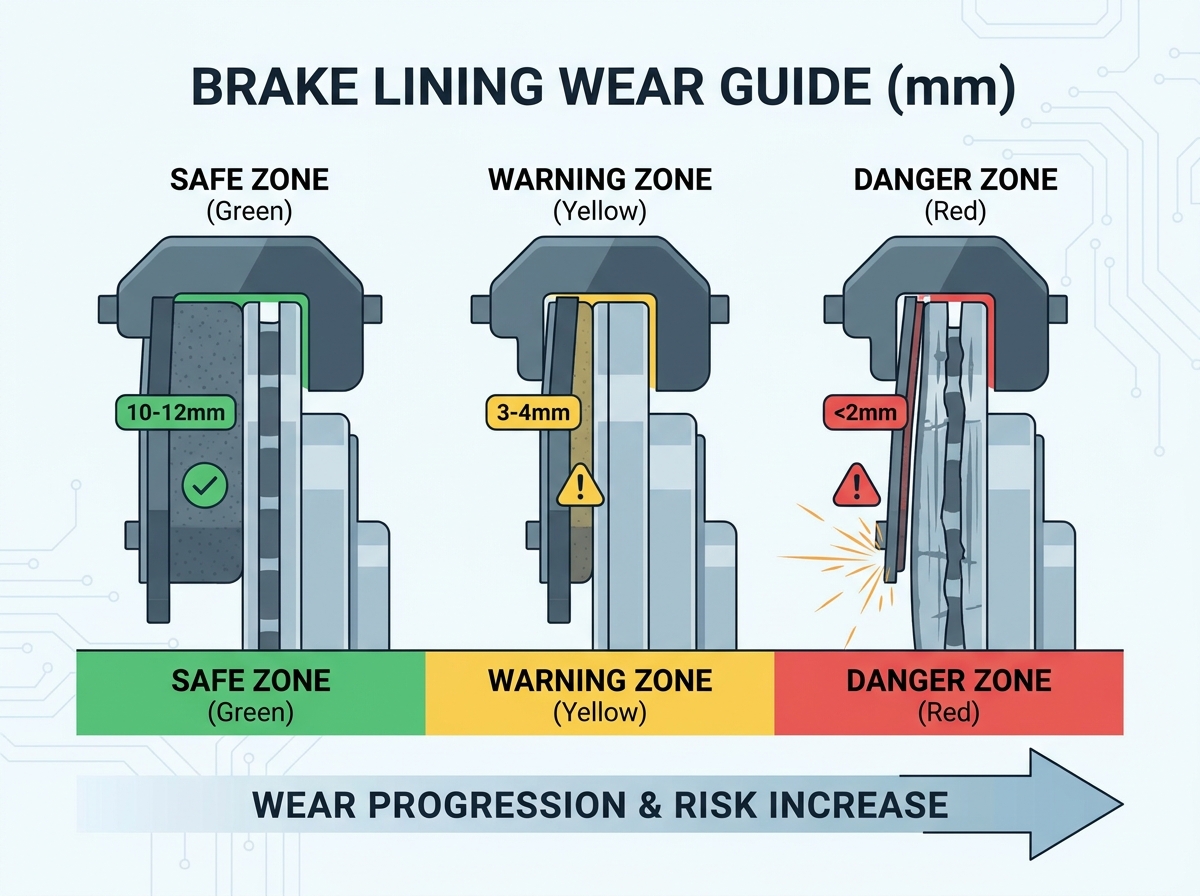
Dealerships frequently use a visual traffic light system for inspections. Green means good. Yellow means caution. Red means danger. This color coding simplifies complex vehicle data for consumers. However, it severely lacks mechanical precision. You should never approve a costly repair based solely on a yellow or red checkmark. You must always ask for the underlying numerical data.
We rely on objective millimeter measurements to evaluate component health. These numbers provide undeniable evidence regarding wear levels. You can easily compare your inspection report against these established industry standards. Understanding the millimeter scale prevents premature part replacements. Dealerships routinely recommend replacing parts at 5mm. They frame this as a proactive safety measure. However, a 5mm pad still retains nearly fifty percent of its usable life. Discarding it wastes your hard-earned money needlessly.
| Thickness Range | Status Category | Recommended Action |
|---|---|---|
| 10mm - 12mm | New Components | Baseline for a brand-new component. No action needed. |
| 5mm - 7mm | Safe/Monitor Range (Yellow) | Wear is occurring. Replacement is not yet necessary. |
| 3mm - 4mm | The "Thin" Warning | Nearing the end of lifecycle. Schedule replacement soon. |
| 1mm - 2mm | Critical Failure Risk (Red) | Metal-to-metal contact is imminent. Replace immediately. |
Mechanics frequently claim you have 20 percent brakes left. This vague statement confuses many drivers. Let us break down the basic math logically. You start out having roughly 10mm of usable material. Reaching 3mm means you consumed 70 percent of it. Therefore, 3mm represents roughly 10 to 15 percent of remaining effective life. Understanding this mathematical conversion removes the mystery from the service desk conversation.
Driving on degraded components seriously compromises your physical safety. Stopping distances increase significantly as the material vanishes. Less material means a severely reduced volume for heat dissipation. High-heat scenarios easily trigger dangerous brake fade. The critical transition happens between 4mm and 3mm. Heat dissipation efficiency drops off a cliff at this specific thickness. The thinner material simply cannot absorb thermal energy properly anymore. The heat transfers directly into the brake fluid instead. Boiling brake fluid causes catastrophic stopping failure. The pedal suddenly feels unnervingly spongy. The vehicle simply refuses to stop quickly. You lose critical reaction time during highway emergencies.
Waiting too long triggers a massive financial snowball effect. The bare metal backing plate eventually grinds aggressively against the rotor. You will hear a horrific scraping noise during every stop. Replacing just the pads costs a relatively modest amount. Grinding destroys the expensive brake rotor completely. Severely scored rotors require immediate replacement. Extreme heat can also permanently damage the hydraulic calipers. The metal piston inside the caliper over-extends when pads become too thin. The rubber dust boot tears open easily. Debris contaminates the delicate internal hydraulic piston. A simple maintenance job quickly becomes a major mechanical overhaul. Your repair bill easily triples if you ignore the warning signs.
Engineers thoughtfully build physical and electronic safeguards into your vehicle. Most modern pads feature mechanical wear indicators. These small metal squeal tabs scrape the rotor intentionally. They emit a piercing, high-pitched squeal to grab your attention. Modern luxury vehicles utilize sophisticated electronic pad wear sensors. These precise sensors trigger an unavoidable dashboard warning light automatically. You should never ignore these vital alerts.
Never accept vague diagnoses from a busy service center. Always ask for the exact measurement in millimeters. A trustworthy shop readily provides this specific number. They keep detailed, precise inspection records for every customer. Mechanics use a specialized tool called a thickness gauge. This simple tool resembles a tiny set of feeler gauges. Each gauge matches a specific millimeter thickness. A technician slips the gauge between the rotor and pad precisely. You have every right to ask them to demonstrate this process. Walk into the service bay safely alongside your advisor. Ask them to point a flashlight directly at the caliper assembly. Seeing the physical evidence builds absolute trust between you and the shop.
You can perform a quick visual check yourself at home. You do not need specialized mechanic tools for this evaluation. If you cannot remove the wheel, use your smartphone creatively. Slide your phone camera through the wheel spokes carefully. Turn the flash on and snap a clear macro photo. Zoom in on the image from the comfort of your home. You can clearly differentiate the shiny metal plate from the dark, dusty friction material.
Your ears and feet provide excellent diagnostic feedback constantly. Pay close attention to how your car behaves during daily commutes.
You can safely delay the job under specific, verified conditions. Imagine your measurements sit comfortably at 4mm to 5mm today. You have no immediate cross-country road trips planned. You hear zero auditory warnings from the wheels. It remains perfectly safe to monitor them closely. Ask the technician to inspect them again during your next scheduled oil change. Save your money for now.
Certain scenarios firmly require immediate authorization from you. Approve the job confidently if brake linings sit at 3mm or strictly below. Weather patterns should also influence your replacement timeline heavily. Approaching winter months demand pristine braking performance. Icy roads amplify the negative effects of diminished stopping power drastically. You want maximum material thickness to handle unpredictable sliding events. Look closely at the brake rotor surface yourself. Deep metallic grooving indicates severe ongoing wear. Blue surface discoloration suggests excessive, dangerous heat damage. Do not delay necessary repairs under these specific, verified conditions.
You must choose replacement materials wisely once you approve the work. Consider your specific driving habits and daily needs carefully.
The phrase thin brake linings acts as a highly beneficial early warning system. It rarely constitutes a valid reason to panic immediately. You now understand how to translate vague subjective warnings into exact millimeter measurements. This knowledge permanently shields you from unnecessary dealership upsells. Follow these core takeaways to maintain your vehicle intelligently. Always ask your technician for exact millimeter measurements instead of accepting vague color codes. Schedule a routine replacement precisely when the friction material reaches the critical 3mm threshold. Visually inspect your own wheels to verify any alarming claims before approving costly repairs. Invest in premium ceramic materials for quieter operation and significantly reduced dust accumulation. Take proactive control of your automotive maintenance today. Request a thorough visual walkthrough with your mechanic confidently. Schedule a prompt replacement using premium aftermarket materials once you verify a breached 3mm safety threshold. Your safety on the road depends entirely on healthy brakes.
A: It entirely depends on the exact thickness measurement. Normal driving remains generally safe at 3mm to 4mm, but it requires heightened caution. Plunging below 3mm increases the risk of catastrophic failure exponentially. You lose crucial stopping power and risk severe rotor damage. Replace them immediately once they breach the 2mm minimum safety threshold.
A: Most brand-new pads start their life around 10mm to 12mm thick. The absolute safety minimum falls between 1mm and 2mm. Reaching the 3mm mark means you consumed the vast majority of the usable material. This measurement represents approximately 10 to 15 percent of your total usable lifespan remaining. Plan your replacement soon.
A: It is not strictly necessary to replace them simultaneously. Mechanics measure the rotor thickness during a standard inspection. You must replace them if they fall below the manufacturer's minimum specification stamped on the hub. Severe warping or deep surface scoring also mandates replacement. Otherwise, you can safely reuse smooth, adequately thick rotors.
A: Wear rates vary wildly based on numerous real-world factors. An aggressive driving style accelerates the degradation process significantly. Stop-and-go city commutes cause much faster wear than smooth highway cruising. Heavier vehicles also demand more friction material to stop. Consequently, a typical set lasts anywhere from 30,000 to 70,000 miles before needing replacement.


