
close
Choose Your Site
Global
Social Media


Views: 0 Author: Site Editor Publish Time: 2026-08-16 Origin: Site


Navigating auto repair terminology often feels incredibly frustrating. You stare at a confusing repair estimate or browse an online parts catalog, completely unsure of what you actually need to purchase. Deciphering mechanic jargon can leave you feeling overwhelmed and highly vulnerable to overspending. You might easily wonder if buying pads automatically covers the heavy metal discs attached to your wheels.
Let us clearly answer this upfront: brake pads, brake linings, and rotors represent fundamentally separate components. Buying or paying for "pads and linings" does not automatically include your vehicle's rotors. We will break down exactly what these specific terms mean and how commercial auto parts stores package them. Finally, you will get an evidence-based framework to decide if you truly need new rotors during your next service visit.
Let us clarify the exact hardware terminology to prevent any future confusion at the repair shop. We hear the term "brake linings" thrown around frequently by service advisors and seasoned mechanics. Technically, the lining serves as the highly engineered, wearable friction material. Manufacturers securely bond or rivet this specific compound to a rigid steel backing plate. In modern disc brake systems, we call this entire assembled unit the "brake pad." The lining takes the absolute brunt of the immense heat and friction generated during rapid deceleration. Engineers design these compounds using semi-metallic, organic, or advanced ceramic materials to withstand thousands of degrees of heat.
Next, let us closely examine the contact surface. The rotor, also known as the brake disc, sits entirely separate from the friction material. It functions as a massive, heavy, rotating cast-iron component. Mechanics mount it directly to your vehicle's wheel hub. As you drive down the highway, this disc spins at the exact same speed as your tires. When you press the brake pedal, hydraulic pressure forces the caliper to squeeze the pads against this spinning rotor. The resulting severe friction physically stops your two-ton car.
We must also provide brief context regarding older vehicles or rear-axle drum configurations. In this specific context, the auto industry still heavily relies on the term "linings." Manufacturers attach this specialized friction material to large, curved metal pieces known as brake shoes. Whether your specific car utilizes modern pads and rotors or traditional shoes and drums, one universal fact remains absolutely constant. The friction material and the metal contact surface always act as highly distinct, separate physical parts. They carry completely separate stock keeping units (SKUs) in any commercial parts catalog or dealership inventory system.
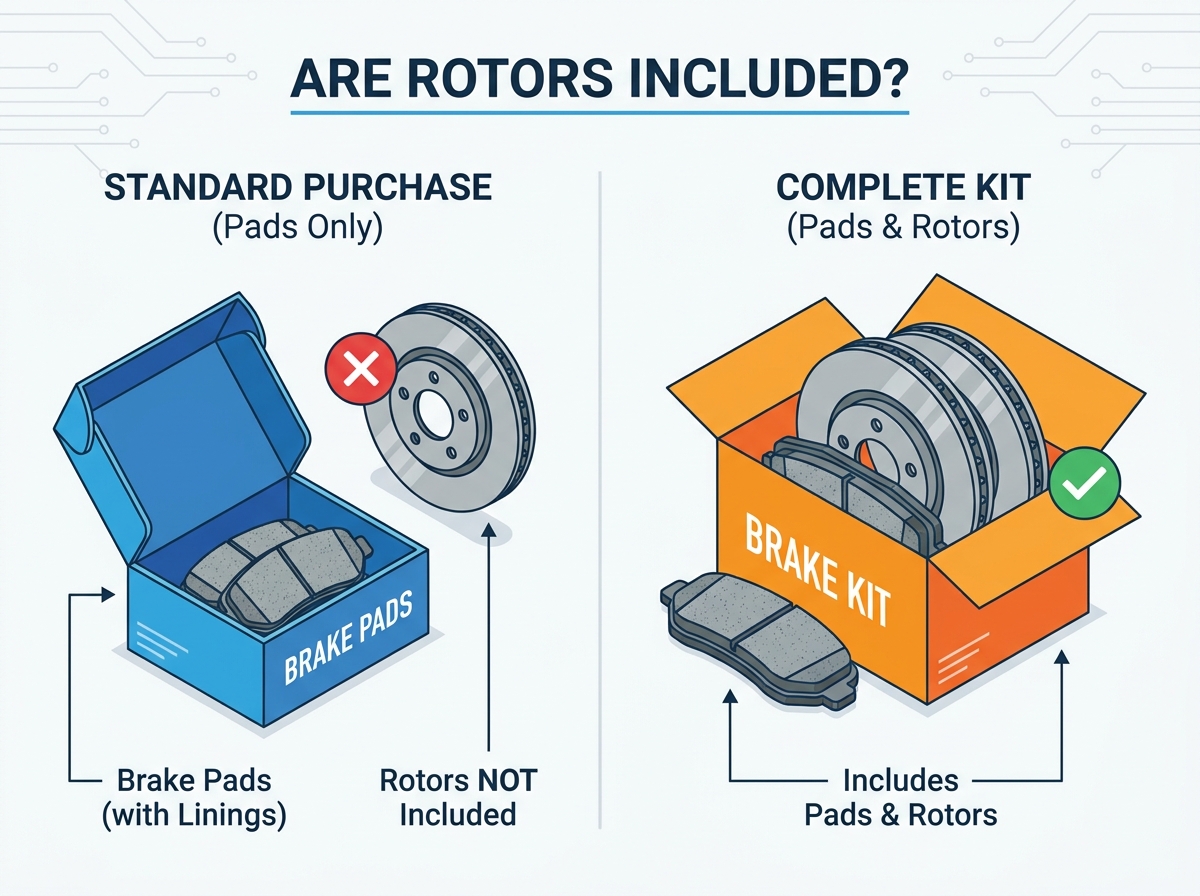
You head down to a local auto parts retailer or browse a major online distributor. You add a standard set of pads to your shopping cart. What exactly arrives at your doorstep? Standard retail packaging usually yields a relatively small, compact box. Inside this package, you will strictly find four individual pads. This specific quantity provides exactly enough hardware to service one single axle (either the two front wheels or the two rear wheels). The box might also include minor optional hardware, such as abutment clips, anti-rattle shims, or a tiny packet of high-temperature grease. You will absolutely never find large iron discs inside this basic standard box.
Retailers only include rotors under very specific, intentional circumstances. You must explicitly purchase a bundled aftermarket package. The automotive industry often aggressively markets these combinations as "Complete Brake Kits," "Z23 Power Kits," or comprehensive "Axle Packs." These massive kits combine four pads, two heavy cast-iron discs, and sometimes even upgraded red powder-coated calipers into one single shipment. Enthusiasts and mechanics favor these bundles because they guarantee perfect compatibility between the friction material compound and the metal surface.
Pricing immediately provides a very clear baseline expectation for consumers. A standalone box of premium ceramic brake linings remains highly affordable for the average driver. You might spend anywhere between $40 and $80 for a high-quality set. However, adding two massive iron discs changes the financial math completely. A bundled kit will rapidly jump to $150 or even exceed $300 per axle. Rotors require enormous amounts of raw cast iron to manufacture. The sheer physical weight and material volume drive up the global manufacturing, warehousing, and shipping costs significantly.
| Part Category | Included Components | Estimated Cost Per Axle | Ideal Buyer |
|---|---|---|---|
| Standard Pads Box | Four brake pads, abutment clips, grease | $40 - $80 | Drivers replacing only the friction material |
| Complete Brake Kit | Four brake pads, two heavy cast-iron discs, hardware | $150 - $300+ | Drivers needing full axle system replacement |
Repair facilities almost always bundle pads and heavy discs together in their initial service quotes. Why do service managers aggressively push this bundled approach? They desperately want to completely avoid costly customer comebacks. Mating perfectly flat, brand-new brake linings to old, deeply grooved metal creates immediate drivability problems. The geometric mismatch causes loud, embarrassing squealing every time you stop at a red light. It often induces intense steering wheel vibration. It also heavily promotes incredibly uneven wear on your fresh, expensive parts. Shops simply want to guarantee a pristine, completely noise-free repair to protect their online reviews and liability.
Historically, highly skilled mechanics offered a fantastic middle-ground solution. They would routinely "turn" or resurface your old, worn discs. They carefully mounted the heavy part on a specialized, highly calibrated brake lathe. The machine would shave off a microscopic layer of metal, completely restoring a perfectly flat, like-new mating surface. Today, however, this practice has largely vanished. Automakers now deliberately manufacture rotors much thinner right out of the factory. This specific design choice shaves precious unsprung vehicle weight and slightly improves overall fuel economy. Unfortunately, it completely changes the repair landscape. Modern parts simply lack the extra structural material needed for safe, repeated machining. Cutting them usually drops the disc completely below legally mandated safe thickness limits. Therefore, full hardware replacement often becomes the only legally compliant and safe option.
We must objectively weigh the severe risks of authorizing a "pad slap." Mechanics use this industry slang term to describe the questionable act of installing fresh pads onto old, scored metal without executing any machining. Yes, it certainly serves as a highly tempting budget-saving tactic when money feels tight. You entirely skip the high cost of purchasing heavy metal parts. However, this massive shortcut severely compromises your vehicle's braking efficiency. The brand-new friction material only makes partial, interrupted contact against the old grooved surface. This lack of contact area drastically increases your emergency stopping distance. It also effectively cuts the expected lifespan of your newly purchased parts right in half.
You absolutely do not need to blindly accept an incredibly expensive repair estimate from a dealership. You can learn to read the document carefully and critically to protect your hard-earned wallet. Professional mechanics should readily present a fully transparent, highly detailed breakdown of the necessary repair work.
Follow these core strategic steps to audit your estimate highly effectively:
Next, you need to confidently spot potential red flags thrown by aggressive service advisors. Some shops strictly mandate complete caliper replacement alongside very standard, routine maintenance. Do not accept this expensive upsell blindly. Ask the advisor for clear physical evidence. Calipers usually only require extremely expensive replacement if an internal hydraulic piston completely seizes in place. You might also need them if the vital protective rubber dust boot tears, allowing water to rust the internal mechanisms. Without seeing this direct visual evidence, you likely only require basic wearable friction components.
Finally, carefully consider the precise cost-to-value ratio of the quoted parts. You will frequently need to choose between expensive Original Equipment Manufacturer (OEM) parts and various aftermarket alternatives. Upgrading to premium ceramic brake linings paired with fully coated, rust-resistant metal discs might cost roughly 15% more upfront at the shop. However, this specific financial investment pays off beautifully. Advanced ceramic materials generate significantly less dark, sticky brake dust, keeping your expensive alloy wheels perfectly clean. Coated metal completely prevents aggressive, ugly rust buildup on the visible central hat. These smart upgrades save you substantial money, stress, and cleaning time over the vehicle's long lifespan.
We strongly recommend making final replacement decisions based solely on hard, verifiable data. You should absolutely never replace heavy, expensive hardware based strictly on an arbitrary mileage interval suggested by a quick-lube shop. Parts wear differently based on driving habits, towing loads, and local traffic conditions.
Every single rotor produced globally features a highly specific, legally mandated "Minimum Thickness" specification. Manufacturers literally stamp a precise "Discard Thickness" number directly onto the central iron hub. If a service advisor aggressively insists you need total replacement, ask them a very simple, direct question. Request the exact micrometer measurement of your current discs. Compare their provided reading directly against the factory discard number. This objective, undeniably accurate measurement completely removes all deceptive guesswork from the repair equation.
Beyond precise tool measurements, specific, undeniable physical symptoms clearly dictate the absolute need for fresh discs. Look out carefully for the following critical warning signs during your daily commute:
You must also carefully diagnose any obvious signs of heavily uneven pad wear. Sometimes, one specific pad wears completely down to the bare metal backing plate, screaming loudly. Yet, the other three corresponding pads on the exact same axle might look practically brand new. This incredibly uneven destruction rarely points to inherently faulty pads. Instead, it strongly indicates a completely frozen caliper slide pin or a severely stuck hydraulic piston. The caliper mechanism fundamentally fails to release pressure smoothly. In these severe mechanical scenarios, the constantly dragging pad completely destroys the metal disc via extreme friction and heat. You will absolutely need to replace the entire ecosystem—rotors, sliding hardware, and pads—together to fully restore safe, reliable operation.
Let us finalize our comprehensive understanding of your vehicle's complex stopping system. We set out to clarify confusing auto industry jargon so you can approach your next maintenance interval with supreme confidence.
First, the friction material and the heavy metal discs act as entirely separate, completely distinct mechanical components. Retailers do not package them mysteriously in the exact same box unless you intentionally select a massive, bundled axle kit. Understanding this packaging reality completely shields you from confusing upcharges.
Second, while bundled, simultaneous replacements guarantee a smooth, quiet ride, you hold the ultimate power to verify the true necessity. Always firmly demand highly objective micrometer measurements from your trusted mechanic to definitively confirm disc thickness and runout prior to authorizing costly repairs.
Third, proactively upgrading to advanced ceramic materials and fully coated metals provides vastly superior long-term automotive value, even despite the slightly higher initial retail costs.
For your immediate next steps, take a very close, critical look at your current written service estimate. Demand a fully itemized breakdown separating technical labor from individual boxed parts. If you plan a rewarding driveway DIY project this weekend, search specifically for complete axle kits online to fully ensure you order every single piece of hardware required for a complete, exceptionally safe repair.
A: Yes, you can replace just the friction material. However, you should only do this if the old discs remain perfectly smooth, unwarped, and measure well above the manufacturer's minimum discard thickness. Installing new pads on highly worn discs severely reduces stopping power, causes excessive squealing, and ruins the new parts quickly.
A: Colloquially, mechanics use the terms interchangeably. Technically, they differ slightly. The lining specifically refers to the wearable friction material itself. Manufacturers permanently attach this material to a solid metal backing plate. Together, the lining and the backing plate form the complete brake pad or brake shoe assembly.
A: Automakers now design modern vehicles using substantially thinner, lighter brake discs to maximize overall fuel economy. Because they start thinner, machining them on a lathe to remove deep grooves often removes too much material. This pushes the disc below the legally safe minimum thickness, requiring complete replacement instead.
A: No, these hardware components are never universally interchangeable. Automotive engineers design stopping systems specifically for a vehicle's unique make, model, production year, and trim level. Variations in wheel size, caliper design, and overall vehicle weight dictate completely different shapes, sizes, and mounting structures for each specific car.


