
close
Choose Your Site
Global
Social Media


Views: 0 Author: Site Editor Publish Time: 2026-09-08 Origin: Site


Quick Answer: Heavy-duty trailer brake linings are critical friction components engineered to safely decelerate high-mass commercial loads by converting massive kinetic energy into thermal energy. Because commercial trailers operate under extreme mechanical stress, selecting the correct friction material requires strict adherence to specific engineering criteria. Procurement managers and technical evaluators must match the brake lining to the trailer’s Gross Axle Weight Rating (GAWR), ensure exact dimensional compatibility with the brake drum, and verify regulatory safety certifications. This article outlines these essential specifications to support informed, safety-compliant procurement decisions for heavy-duty fleet operations.
Key Takeaways:
Heavy-duty brake linings must convert massive kinetic energy into heat without experiencing severe thermal degradation or brake fade.
Component selection is strictly governed by Gross Axle Weight Ratings (GAWR), often requiring linings engineered to support 20,000 lbs, 23,000 lbs, or higher.
Dimensional compatibility is non-negotiable; a lining must precisely match the brake drum diameter (e.g., 419mm) to ensure safe, distributed surface contact.
Regulatory compliance, such as FMVSS 121 and standardized WVA numbering, verifies stopping distance, stability, and performance under maximum payload conditions.
The fundamental function of any braking system is the conversion of kinetic energy into thermal energy through mechanical friction. In heavy-duty commercial trailers, this process occurs on a massive scale. The kinetic energy of a moving vehicle is proportional to its mass and the square of its velocity. Because commercial trailers frequently haul payloads tens of thousands of pounds heavier than passenger vehicles, the kinetic energy involved at highway speeds is exponentially greater.
When the air brake system is actuated, pneumatic pressure forces the brake shoes outward, pressing the attached brake linings against the interior surface of the rotating brake drum. The resulting friction generates the necessary drag to decelerate the vehicle. During this process, the brake lining acts as the primary thermal interface. The thermal energy generated during a heavy braking event can cause drum temperatures to spike dramatically, often exceeding several hundred degrees.
The core function of a heavy-duty brake lining is not just to create friction, but to maintain a consistent coefficient of friction under these extreme temperature conditions. If a brake lining cannot adequately manage this heat, the friction material may glaze or chemically degrade, leading to a dangerous condition known as brake fade. Brake fade results in a significant loss of stopping power, requiring the operator to apply increasing pneumatic pressure to achieve the same deceleration. Therefore, heavy-duty brake linings are engineered with specialized material formulations designed to dissipate heat rapidly, resist thermal breakdown, and provide reliable, repeatable stopping power over long descents and repeated braking cycles.
The amount of kinetic energy a braking system must convert directly depends on the mass of the vehicle. Therefore, the physics of heavy-duty braking dictate that brake linings must be selected based on the specific load capacities they are engineered to handle. In commercial transport, this is quantified by the Gross Axle Weight Rating (GAWR).
GAWR is the maximum distributed weight that a single vehicle axle system can safely support, factoring in the dynamic weight transfer that occurs during deceleration. Brake linings must be formulated and manufactured with the structural integrity, shear strength, and compressive resistance necessary to halt that specific weight class. Installing a brake lining rated for a lower GAWR on a high-capacity axle will result in accelerated wear, thermal overloading, and potential catastrophic failure of the friction material during emergency stops. For procurement managers, matching the lining to the GAWR is the first step in ensuring fleet safety and minimizing unscheduled maintenance downtime.
Zhejiang Dingchi Automotive Technology Co., Ltd. manufactures heavy-duty friction components specifically engineered to meet these high-stress demands. For example, the company’s 4551 Brake Lining is explicitly designed for high-capacity applications. It supports Gross Axle Weight Ratings (GAWR) of 20,000 lbs, 23,000 lbs, and higher, making it a top choice for fleet operators hauling heavy cargo. By supporting these elevated weight ratings, the lining provides a critical safety margin for fully loaded trailers operating under demanding conditions.
Important limitation: The stated GAWR capacities of 20,000 lbs and 23,000 lbs apply specifically to the 4551 Brake Lining model. Load capacities vary across different lining specifications, and procurement teams must always verify that the chosen component matches the GAWR of the specific trailer axle being serviced.
While a high load capacity is a prerequisite for heavy-duty applications, that capacity is entirely ineffective without exact dimensional mating between the brake lining and the brake drum. The physical geometry of the braking system determines how effectively friction is applied and how heat is distributed across the braking surface.
Brake linings are manufactured with a specific arc that must perfectly match the internal curvature of the brake drum. If the lining radius is too small or too large for the drum, the friction material will only make partial contact. This point-loading creates severe hot spots, uneven wear, and drastically reduced stopping power. Over time, these hot spots can lead to heat checking (micro-cracking) on the drum surface, drum scoring, and premature lining failure. Because of these strict geometric requirements, brake linings are not universally interchangeable across all commercial trailers.
Dimensional compatibility is dictated by the axle and drum specifications rather than the trailer brand alone. For instance, the 4551 Brake Lining is engineered precisely for YORK and FRUEHAUF trailers that utilize 419mm brake drums. Procurement managers must ensure that the lining arc, width, and thickness correspond exactly to the 419mm drum dimensions to ensure full surface contact and safe operation. Furthermore, the rivet hole patterns must align perfectly with the brake shoe to ensure secure mechanical fastening.
When evaluating replacement parts, fleet operators must navigate a wide catalog of Brake Linings to find the exact dimensional match for their specific axle configurations, as no single lining specification can safely accommodate all trailer models.
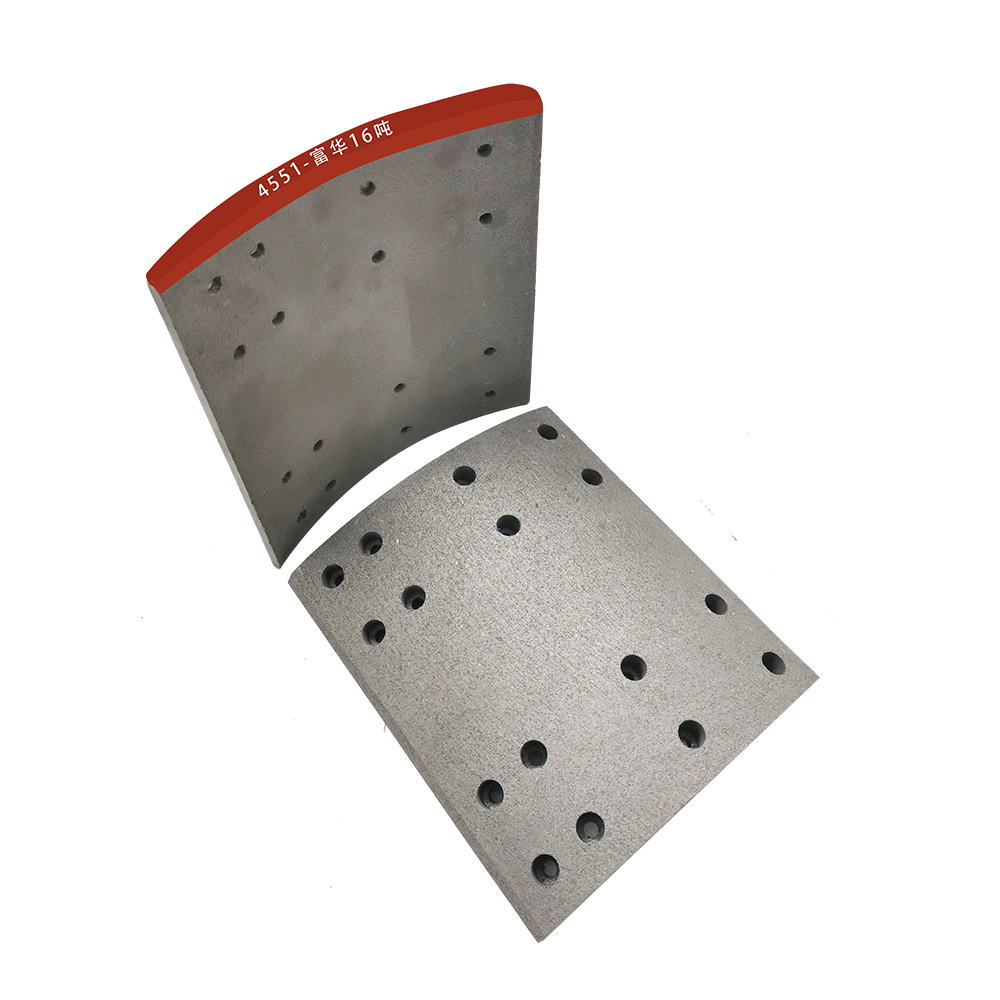
Physical fit and theoretical load capacity must be objectively validated through standardized regulatory testing. In the B2B procurement of heavy-duty vehicle components, safety certifications are critical risk mitigation tools. They provide independent verification that a brake lining will perform reliably under maximum payload and extreme operational conditions, protecting both the fleet operator and the public.
Two of the most critical compliance frameworks in the global commercial vehicle market are FMVSS 121 and the WVA numbering system:
FMVSS 121 (Federal Motor Vehicle Safety Standard No. 121): This standard establishes performance and equipment requirements for braking systems on vehicles equipped with air brakes. It mandates strict criteria for stopping distance, lateral stability, and brake actuation/release timing. For example, it tests the vehicle's ability to stop from a specified speed within a maximum distance without leaving a designated lane. Compliance ensures the brake lining can safely halt a fully loaded trailer within legally required distances without loss of control.
WVA Numbering System: Developed by the German Federal Motor Transport Authority, the WVA (Waren-Vertriebs-Artikel) system is an internationally recognized standardized identification system for friction materials. It categorizes brake linings by their exact dimensions, shape, and intended applications. This system ensures cross-border consistency in procurement, allowing buyers to confidently cross-reference parts and avoid costly fitment errors.
Meeting these strict international standards is necessary for global distribution. Dingchi exports to over 20 countries, requiring adherence to diverse regulatory frameworks to meet the needs of international fleets. The 4551 Brake Lining, for example, is fully compliant with FMVSS 121 and holds the WVA# 19069/70 certification, validating its performance in heavy-duty applications.
Important limitation: Compliance with FMVSS 121 and the WVA# 19069/70 designation are specific to the 4551 Brake Lining model. Procurement teams must request and verify the specific certification documents for any individual brake lining specification being evaluated for fleet use.
Achieving the high load capacities required by heavy-duty GAWRs and passing the rigorous testing mandated by FMVSS 121 requires highly specific friction material formulations. The underlying material science of a brake lining dictates its operational characteristics, including its coefficient of friction, heat dissipation rate, acoustic properties, and overall service life.
Heavy-duty brake linings are typically composed of a complex matrix of materials, including binding resins, structural fibers, friction modifiers, and fillers. The exact ratio of these components determines how the lining behaves under stress. For example, some formulations prioritize aggressive stopping power and high-temperature stability for mountainous terrain, while others are optimized for long-term wear resistance and drum preservation in long-haul, flat-highway applications.
Because operational needs vary drastically across different fleets, climates, and cargo types, manufacturers must offer a diverse portfolio of friction materials. A lining that performs exceptionally well on a logging trailer may wear too quickly on a line-haul freight trailer. Dingchi produces over 50 specifications of brake linings and over 90 specifications of brake shoes to accommodate these varied engineering requirements.
Understanding what friction materials are used for brake linings allows technical evaluators to select a formulation that balances stopping power, drum preservation, and maintenance intervals for their specific operational environment.
Excessive heat can cause thermal degradation of the binding resins within the friction material. When a heavy-duty trailer descends a long grade, the continuous friction generates immense thermal energy. If temperatures exceed the lining's operational threshold, the material can glaze—creating a hard, smooth surface that drastically reduces the coefficient of friction. This results in brake fade, where the trailer loses stopping power despite maximum air pressure being applied to the brakes. High-quality linings are formulated to resist this glazing and maintain friction consistency at elevated temperatures.
A WVA number is an internationally recognized identification code that standardizes the dimensions, shape, and application of friction materials. In B2B procurement, referencing a specific WVA number (such as WVA# 19069/70) ensures that the buyer receives a brake lining with the exact geometric specifications required for their specific brake drum and shoe assembly. This standardized system eliminates fitment errors, streamlines global supply chains, and ensures that replacement parts meet the original equipment's dimensional tolerances.
Yes, but only if those different trailer brands utilize the exact same axle and brake drum dimensions. Brake lining compatibility is determined by the drum diameter (e.g., 419mm), shoe geometry, and rivet patterns, not the badge on the trailer. For example, a single lining specification can fit both YORK and FRUEHAUF trailers provided both are equipped with the specific 419mm brake drum the lining was engineered to match. Procurement must always verify axle specifications rather than relying on trailer make alone.
FMVSS 121 is a critical safety standard that dictates the maximum allowable stopping distance and requires the vehicle to remain stable within a specified lane during emergency braking. Compliance verifies that the brake lining, when integrated into an air brake system, can safely decelerate a fully loaded commercial trailer under real-world emergency conditions. This mitigates the risk of jackknifing or collisions, ensuring that the fleet operates within legal safety parameters and reducing liability for the operator.
To ensure your fleet meets required Gross Axle Weight Ratings and international safety standards, review our technical specifications or consult our product catalog to find the correct heavy-duty brake linings engineered for your specific 419mm drums and trailer configurations.


