

close
Choose Your Site
Global
Social Media


Views: 0 Author: Site Editor Publish Time: 2026-08-01 Origin: Site


Selecting brake linings is much more than a routine mechanical necessity. It acts as a critical variable impacting vehicle safety, regulatory compliance, and overall system longevity. Every time a vehicle stops, kinetic energy transforms into massive amounts of heat. Modern braking systems operate under extreme thermal and mechanical stress every single day. We have largely moved past outdated, hazardous materials like asbestos. Today, we rely on highly engineered friction composites. These advanced materials must survive brutal conditions without crumbling or fading. Choosing the perfect material requires a careful balancing act. You must evaluate baseline friction coefficients alongside heat dissipation capabilities. Furthermore, emerging environmental regulations are forcing rapid changes in material science. We will explore the primary friction categories, key evaluation dimensions, and practical implementation strategies to help you make informed procurement decisions.
Making the wrong component choice impacts the entire operation. Procurement teams often look at the initial purchase price. However, we must focus on the complete maintenance lifecycle. Purchasing cheaper friction materials upfront often creates long-term mechanical headaches. Budget-friendly pads frequently lead to accelerated rotor wear. Mechanics must replace damaged rotors more often. This directly increases long-term maintenance burdens. Vehicle downtime also spikes. You must evaluate the lifespan of the entire wheel end. A slightly higher upfront investment often yields significantly longer intervals between shop visits.
Safety and performance predictability remain non-negotiable. Predictability literally saves lives. Drivers face extreme danger from a phenomenon called "brake fade." Brake fade occurs when friction drops drastically under high temperatures. The brake pedal feels firm, but the vehicle refuses to stop. Consistent friction coefficients across a wide temperature band are critical success criteria. You need brakes to bite reliably. They must perform whether freezing cold in winter or blistering hot descending a mountain. Unpredictable performance leads to accidents, liability, and compromised operator safety.
We must also consider the NVH factor. NVH stands for Noise, Vibration, and Harshness. It directly impacts driver fatigue and customer satisfaction. Squealing brakes irritate operators during long shifts. Severe vibration makes a vehicle feel cheap or broken. Customers perceive quiet, smooth stops as an indicator of high vehicle quality. Excessive harshness can also loosen surrounding suspension components over time. Managing NVH improves the driving experience and protects adjacent mechanical parts from vibrational damage.
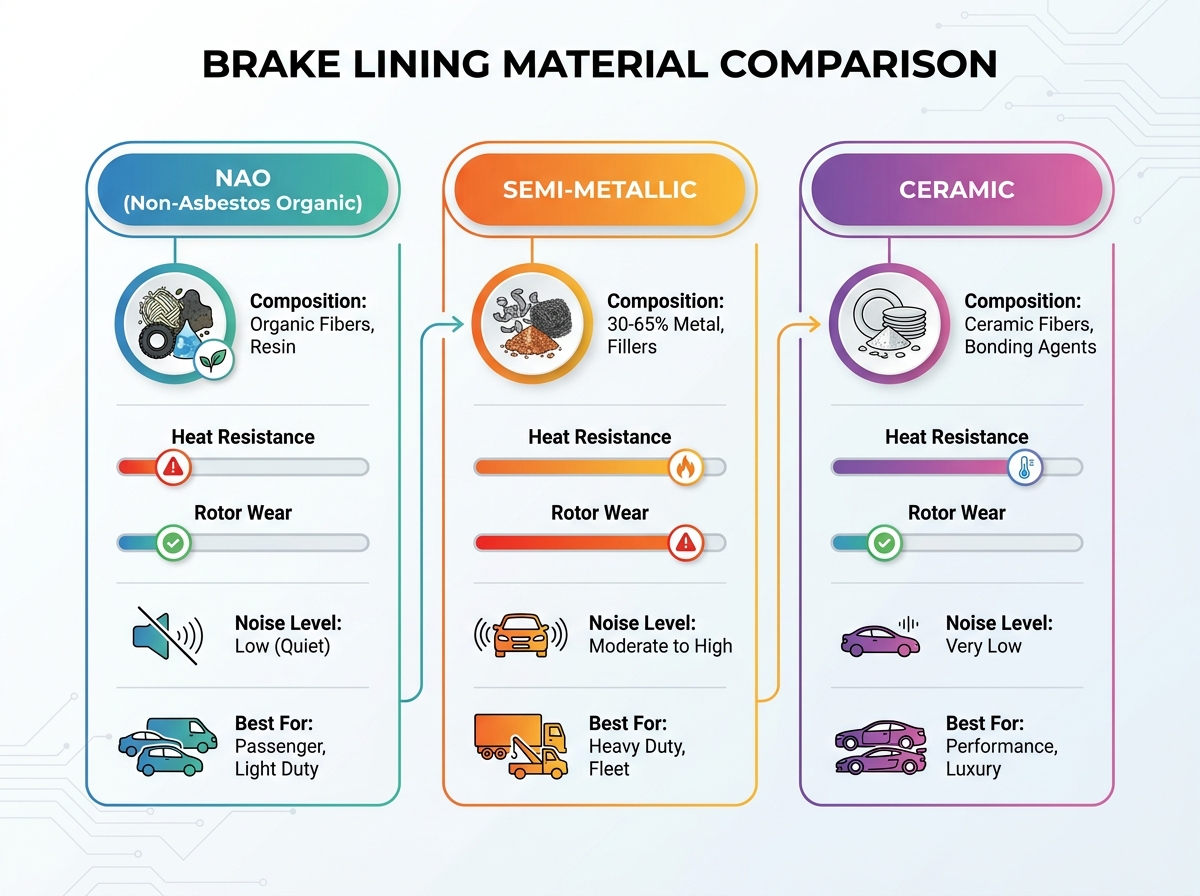
Manufacturers engineer NAO materials from various organic fibers. These include glass, rubber, Kevlar, and carbon. High-temperature resins bind these fibers together into a solid block. The industry developed these blends specifically to replace toxic asbestos. The manufacturing process focuses on creating a softer, more forgiving pad.
The performance profile of NAO shines in specific areas. It offers excellent NVH control. These pads operate very quietly during routine stops. They also produce exceptionally low rotor wear. The softer material sacrifices itself rather than chewing into the cast-iron rotor. Drivers enjoy a smooth, predictable pedal feel during normal city driving.
However, NAO materials carry notable limitations. They exhibit faster wear rates under heavy loads. High heat causes the binding resins to vaporize. This vaporization creates a gas cushion between the pad and rotor, known as outgassing. Outgassing drastically reduces friction. Therefore, NAO has a much lower thermal threshold. It presents a higher risk of brake fade in heavy-duty applications.
Semi-metallic pads contain a significant volume of metal. This composition typically ranges from 30% to 65% metallic content. Manufacturers use steel wool, iron powder, and copper flakes. They combine these metals with specialized friction modifiers and graphite fillers. The metallic structure creates an incredibly dense and rigid braking puck.
This category delivers a robust performance profile. It provides superior heat dissipation. Metals conduct heat efficiently, pulling thermal energy away from the rotor face. Semi-metallic pads boast a very high thermal threshold. They resist fading during intense, repeated deceleration. They also offer excellent "cold bite." The brakes grip aggressively even before reaching optimal operating temperatures.
The limitations stem from this aggressive nature. Semi-metallic materials are highly abrasive. This abrasiveness significantly increases rotor wear over time. They also weigh more than other materials. Drivers often experience higher noise levels, including squeaks and grinding sounds. Finally, these pads produce a dark, highly corrosive brake dust. This dust can ruin alloy wheels if ignored.
Ceramic formulations represent advanced materials engineering. Manufacturers use dense ceramic fibers and strong bonding agents. They often include non-ferrous metal fillers. Copper was traditionally used to aid heat transfer. However, manufacturers are actively decreasing copper usage due to new compliance laws. The resulting material is exceptionally hard and durable.
The ceramic performance profile appeals to many premium users. It provides a stable friction coefficient across broad temperature ranges. These pads produce extremely low noise. The frequencies generated during stops often fall outside human hearing ranges. They also produce a very light, fine brake dust. This non-corrosive dust keeps wheels looking clean.
Despite these benefits, ceramic has distinct limitations. High manufacturing costs make them expensive. They often deliver poor performance in extreme cold environments before warming up. Crucially, ceramic acts as an insulator rather than a conductor. It does not absorb heat well. It transfers thermal stress directly into the rotor and brake fluid. This can cause fluid boiling in extreme track or heavy towing conditions.
| Material Category | Heat Dissipation | Rotor Wear Rate | NVH Control | Thermal Threshold |
|---|---|---|---|---|
| Non-Asbestos Organic | Low | Very Low | Excellent | Low |
| Semi-Metallic | Excellent | High | Poor | High |
| Ceramic | Poor (Insulator) | Low | Outstanding | Moderate-High |
Understanding the Coefficient of Friction (μ) is paramount. You must know how to read DOT edge codes printed on the pad backing. These two-letter codes indicate friction performance. The first letter represents the cold friction rating. The second letter represents the hot friction rating. Letters range from E to H. For example, a code of "EE" indicates moderate friction both cold and hot. A code of "FF" indicates higher friction. A "GG" code offers aggressive stopping power. If you see an "FE" code, the pad grips well cold but fades when hot. Evaluating these codes helps you match the pad to the operational demand.
Thermal management and heat dissipation require careful scrutiny. You must evaluate a material's ability to resist glazing. Glazing occurs when extreme heat melts the pad surface. It crystallizes into a hard, slick layer. A glazed pad cannot generate sufficient friction. You need materials that maintain structural integrity during repeated, high-speed decelerations. Proper heat dissipation prevents caliper seals from melting. It also stops brake fluid from boiling, which causes immediate system failure.
Compressibility and shear strength are physical attributes you cannot ignore. Compressibility dictates the brake pedal feel. High compressibility results in a spongy, unresponsive pedal. Low compressibility delivers a firm, confidence-inspiring pedal. Shear strength assesses the material's physical resistance to crumbling. The friction puck must remain attached to the steel backing plate. Under extreme hydraulic pressure, weak bonds will shear off. This leads to catastrophic brake failure.
Environmental compliance and security dictate future availability. The industry must navigate the "Better Brake Rule." This critical legislation mandates the phase-out of copper and heavy metals. Environmental agencies found these metals wash into storm drains and harm local waterways. We are witnessing a massive industry shift toward copper-free formulations. You will often see an "N-leaf" compliance stamp on approved products. Procurement teams must source environmentally compliant brake linings to avoid future supply chain disruptions.
Even the best materials fail if implemented poorly. The component mismatch risk remains a massive threat. We strongly warn against pairing aggressive semi-metallic pads with standard cast-iron rotors. Economy rotors are not rated for high abrasion. The metallic pads will chew through the soft iron rapidly. This creates deep grooves and excessive heat. You must match the metallurgy of the rotor to the aggressiveness of the pad. High-carbon rotors pair best with heavy-duty metallic pads.
Bedding-in procedures are a mechanical reality you cannot skip. Friction relies on the "transfer layer." Adhesive friction occurs when a microscopic layer of pad material melts onto the rotor face. Friction materials require specific break-in protocols to establish this layer. Drivers must perform a series of controlled stops from specific speeds. They must let the brakes cool adequately afterward. Failure to bed the brakes properly results in severe judder. It causes uneven pad deposits and premature failure.
Operating environment vulnerabilities expose weak formulations. Environmental factors heavily compromise specific materials. Excessive moisture reduces initial bite. Heavy road salt causes a phenomenon called "rust jacking." Rust forms between the friction material and the backing plate, prying them apart. Extreme freezing temperatures can make certain NAO blends brittle. You must assess the typical weather and road conditions your vehicles face daily. Select a formulation engineered to withstand those specific environmental threats.
Selecting the optimal material requires a logical framework. You must match the material's strengths to the specific use-case. Consider the following application profiles:
Evaluators should take specific next steps. First, demand comprehensive spec sheets from suppliers. Focus heavily on temperature versus friction graphs. Do not rely solely on marketing claims. Second, conduct a limited fleet pilot. Install the short-listed brake linings on a small test group of vehicles. Monitor their performance, wear rates, and driver feedback over three months. Proceed with bulk procurement only after validating the pilot data.
Specifying the correct friction materials is an intricate exercise in managing thermal dynamics. You are always navigating operational trade-offs. There is no magical "silver bullet" that offers maximum friction, zero wear, and zero noise simultaneously. Every choice requires prioritizing certain performance metrics over others based on your specific application.
We highly encourage you to audit your current fleet's brake wear patterns. Inspect discarded rotors and pads for signs of glazing, uneven wear, or heat checking. Consult directly with a friction material engineer to align your material selection with actual operational demands. Proactive evaluation ensures maximum safety, regulatory compliance, and prolonged system health.
A: No. Strict global bans largely eliminated asbestos due to severe health risks, specifically mesothelioma. Manufacturers successfully replaced asbestos with Non-Asbestos Organic (NAO) blends. These modern organic and synthetic fibers provide safe, effective friction without the deadly respiratory hazards associated with outdated asbestos dust.
A: Ceramic pads generally offer the longest pad lifespan. However, "longest life" for the pad might mean shorter life for other components. Semi-metallic pads last long under heavy stress but aggressively wear down the rotor. Ceramic preserves the rotor but transfers heat into the caliper. Evaluate the entire system's lifespan.
A: Regulatory laws now mandate phasing out copper to protect aquatic ecosystems. Manufacturers previously used copper for its excellent heat transfer capabilities. "Copper-free" means manufacturers now utilize advanced synthetic alternatives and proprietary metallurgical blends. These new formulations successfully maintain required heat dissipation levels without relying on toxic heavy metals.
A: It dictates the type of wear. Semi-metallic materials use abrasive friction, which physically grinds away the cast-iron rotor over time. This significantly shortens rotor lifespan. Conversely, organic and ceramic materials use adhesive friction. They leave a microscopic transfer layer on the rotor, protecting the iron and extending its life.


